
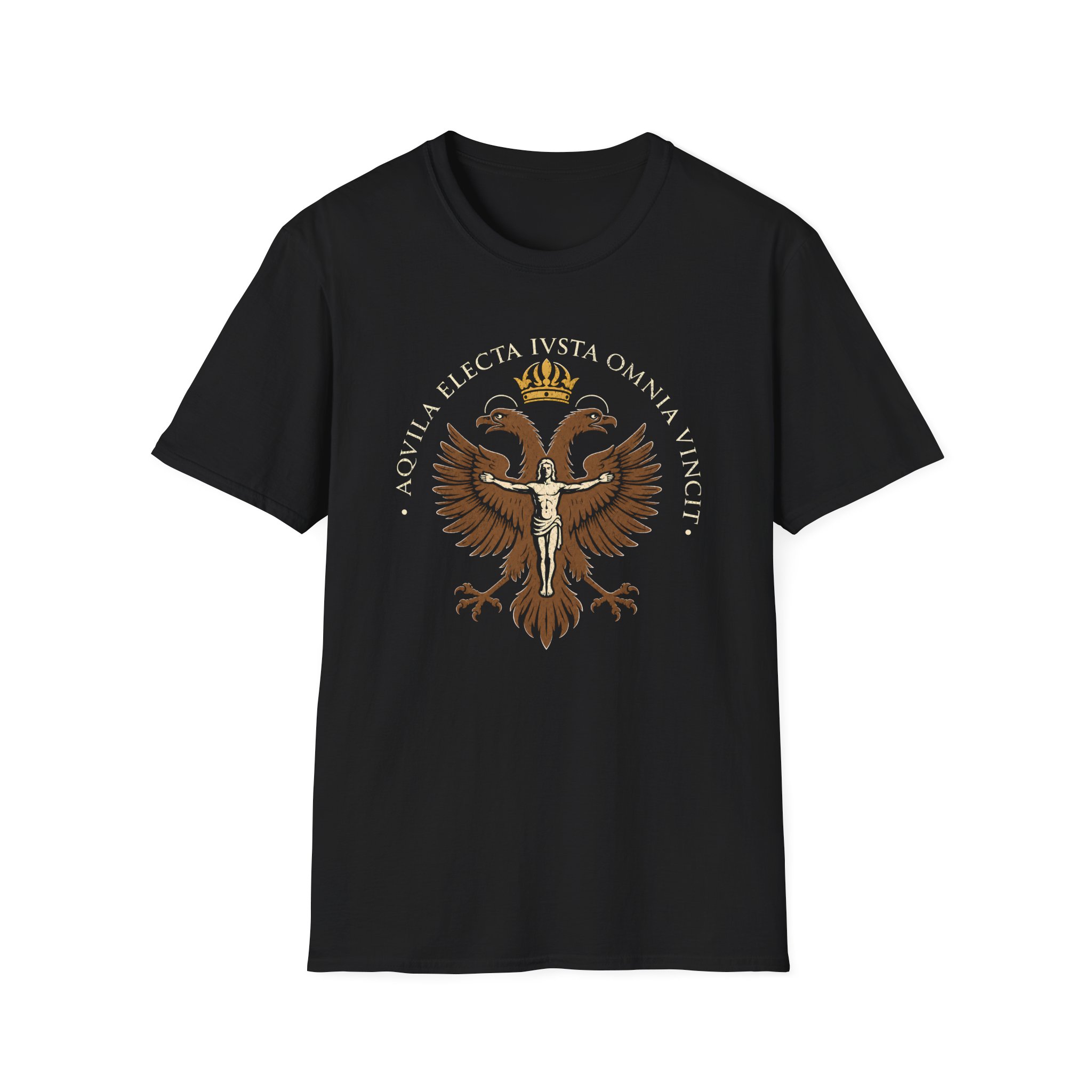
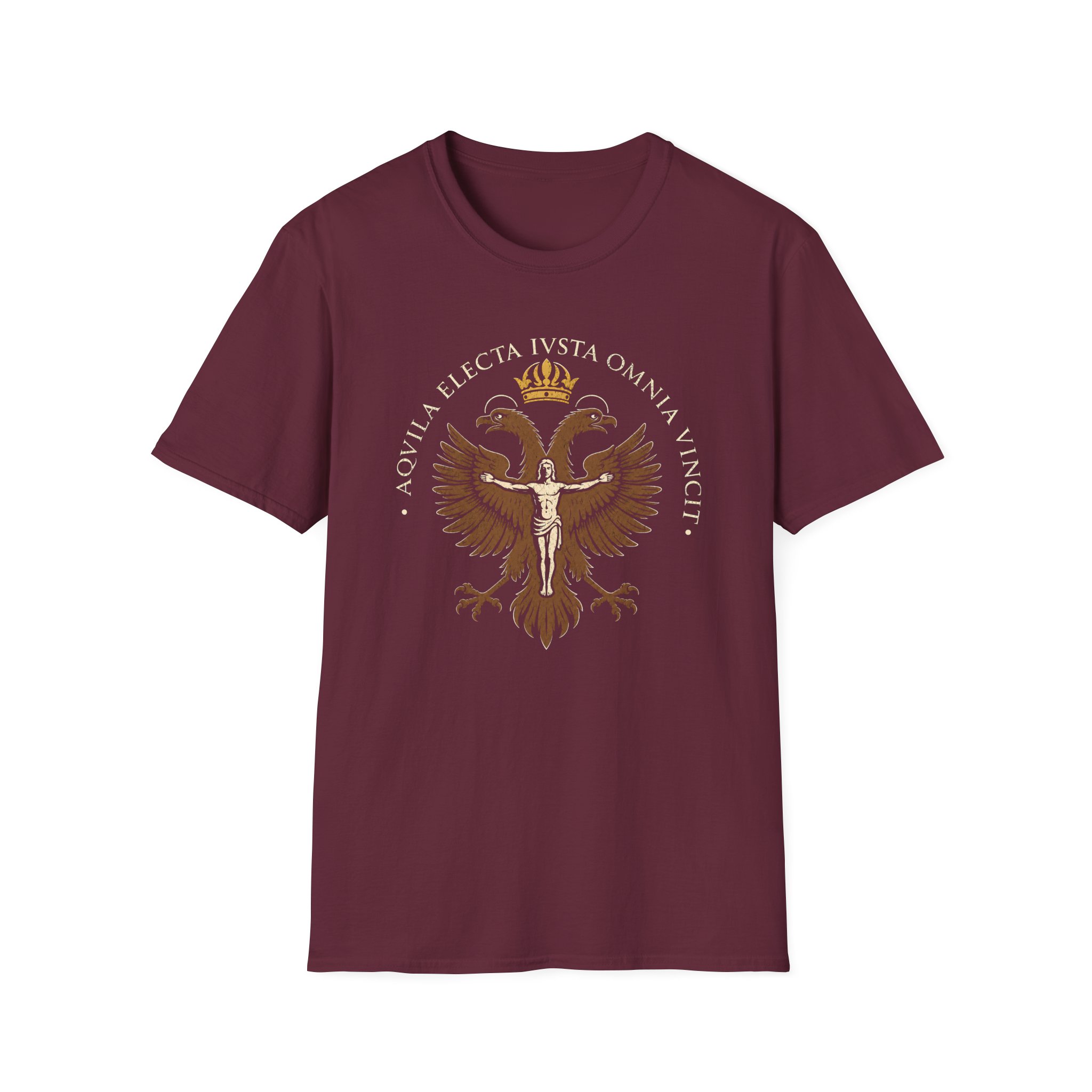
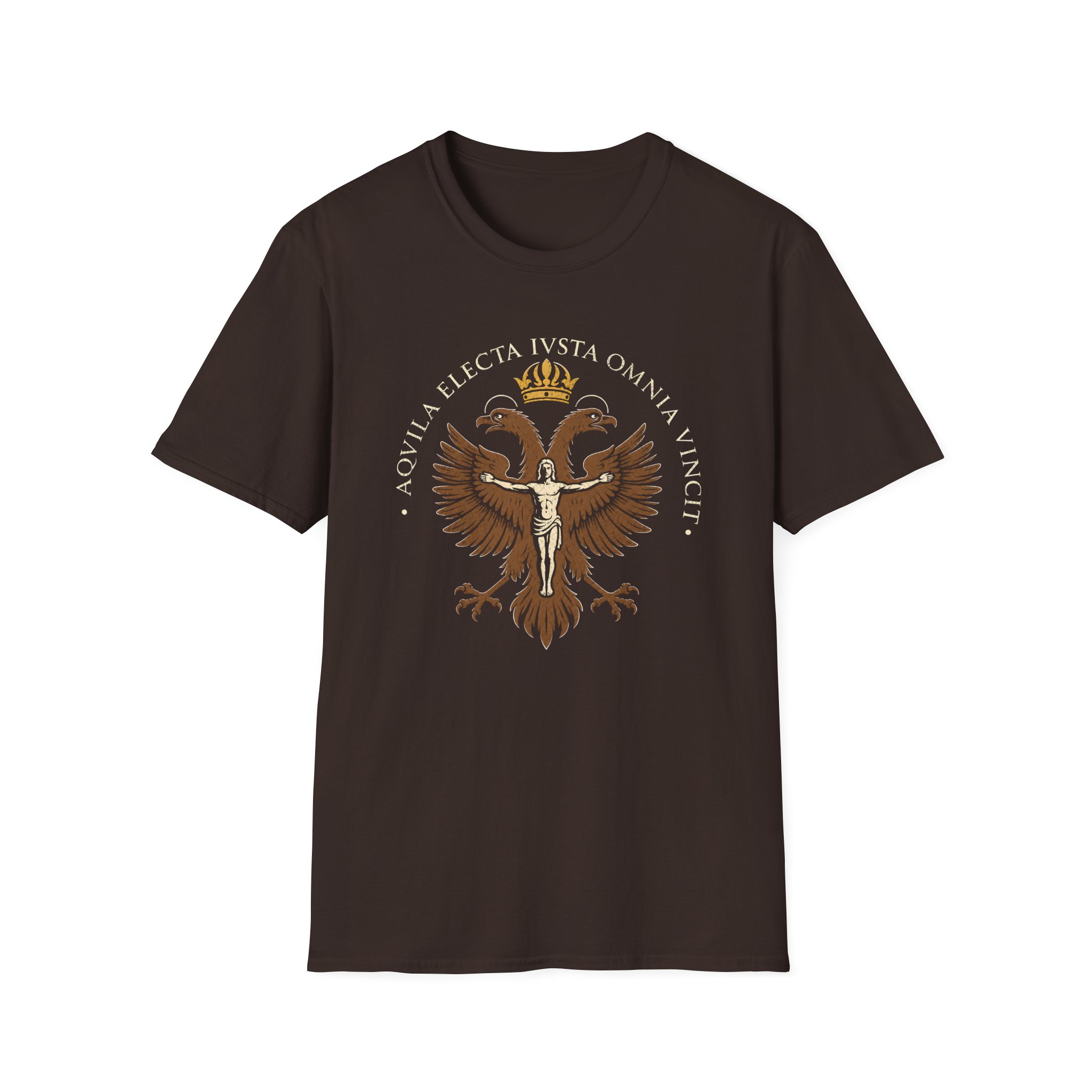
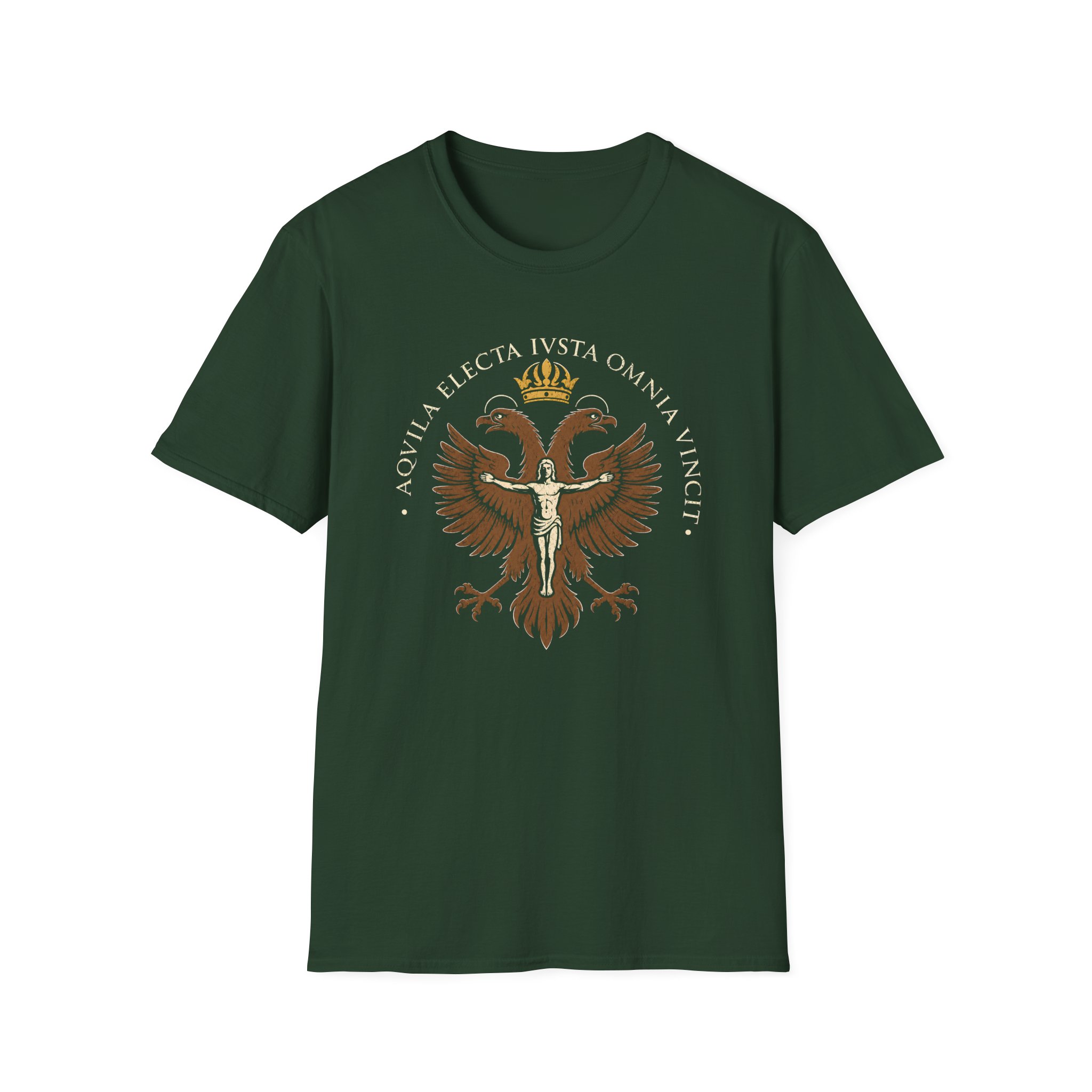
AQVILA ELECTA IVSTA OMNIA VINCIT
“The chosen and righteous eagle conquers all.”
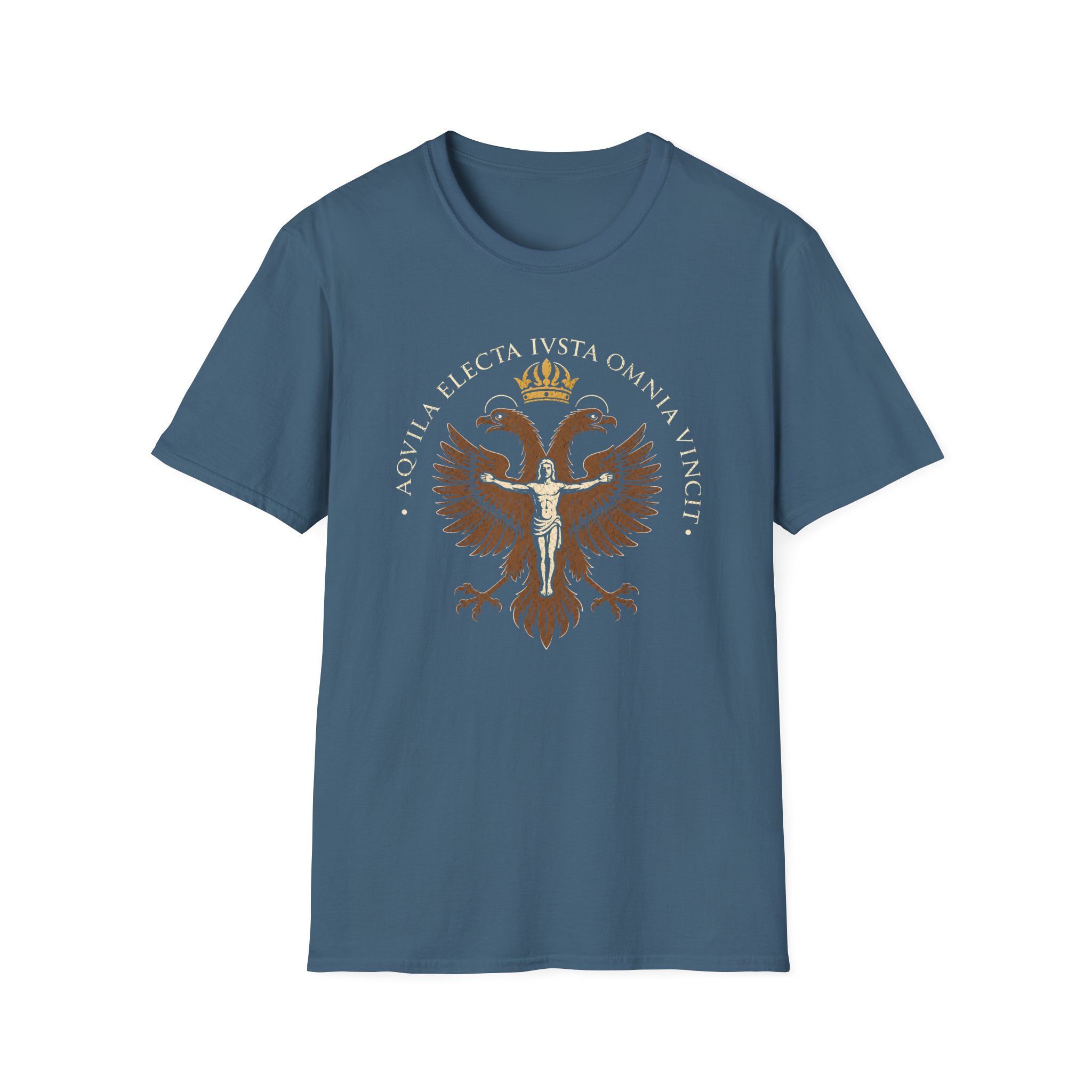
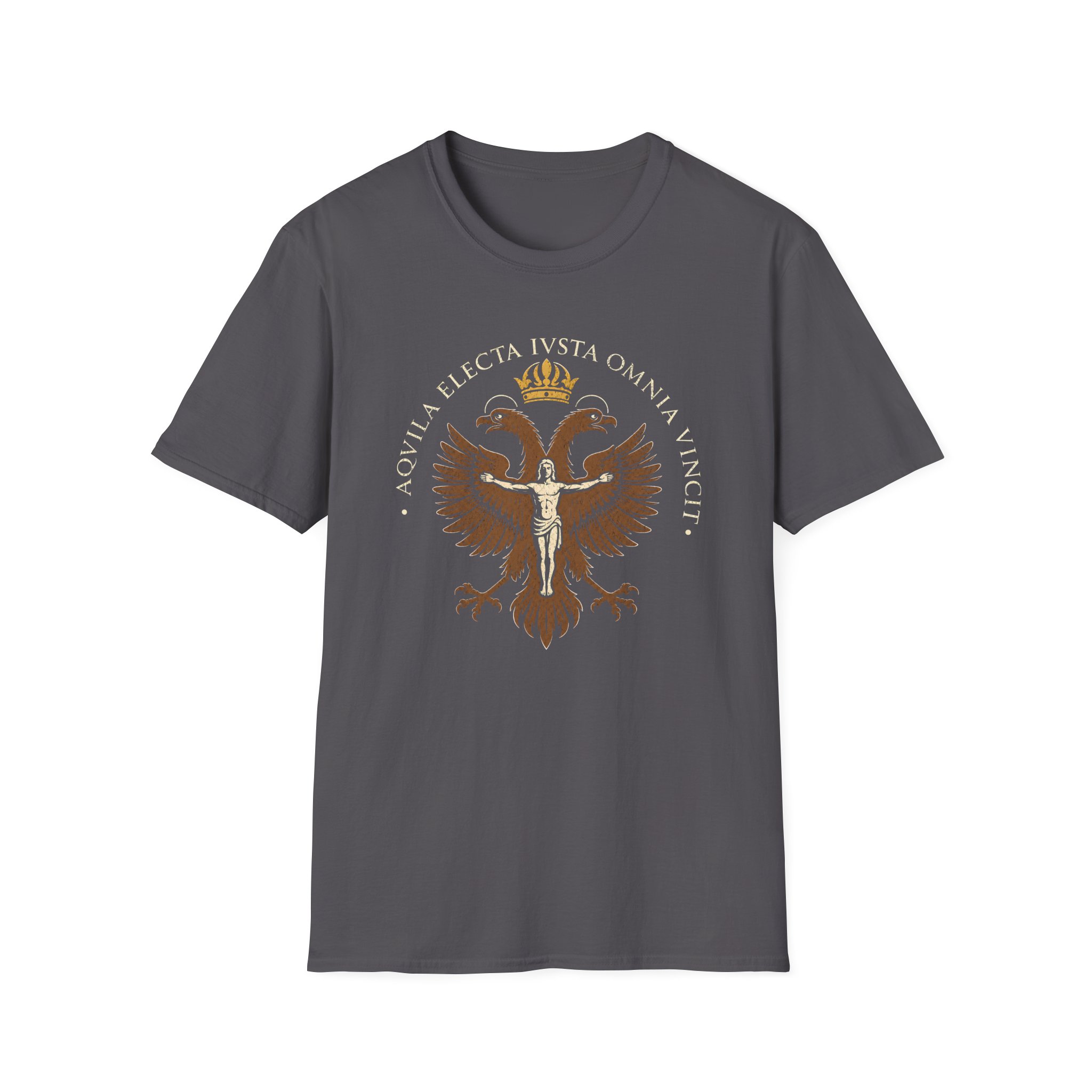
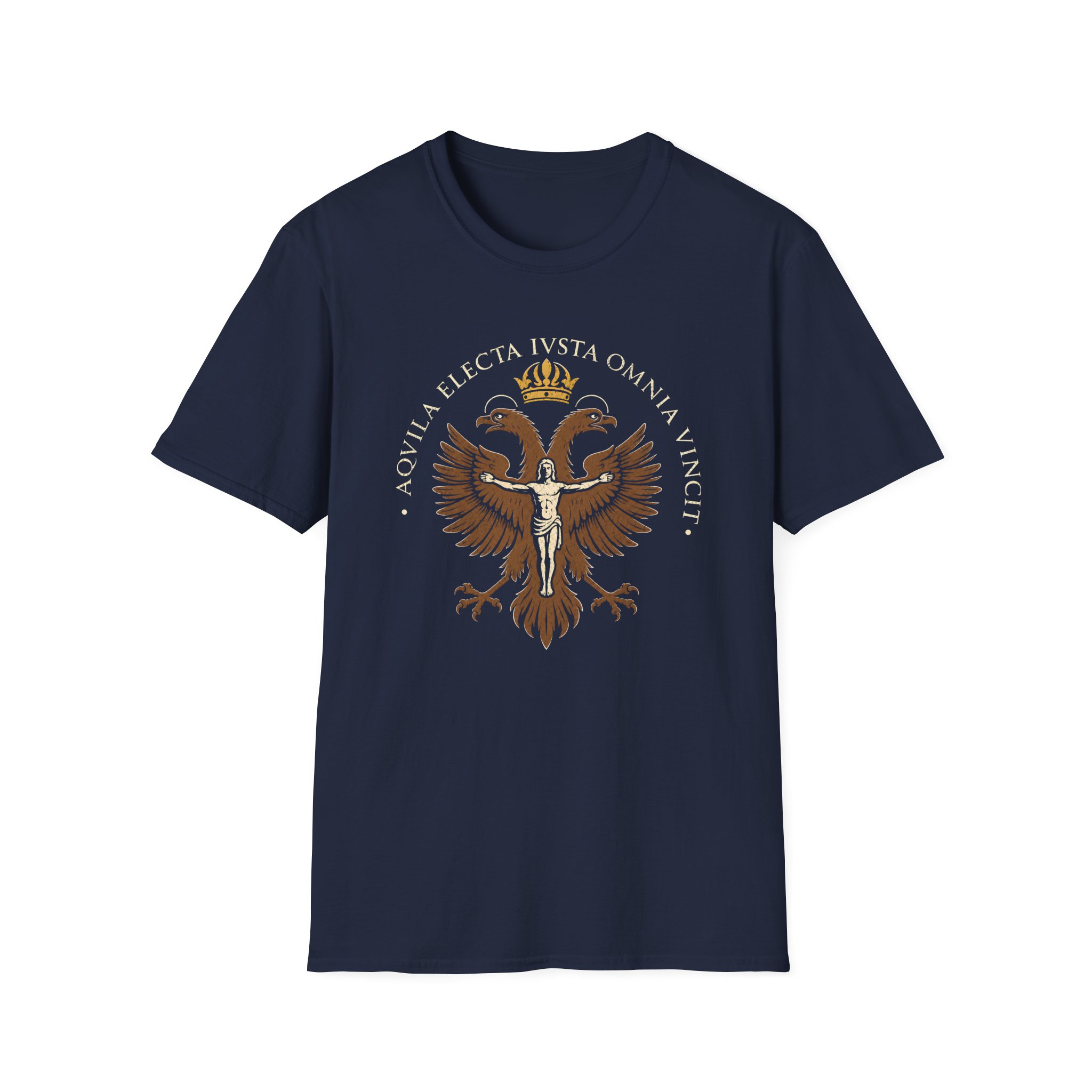
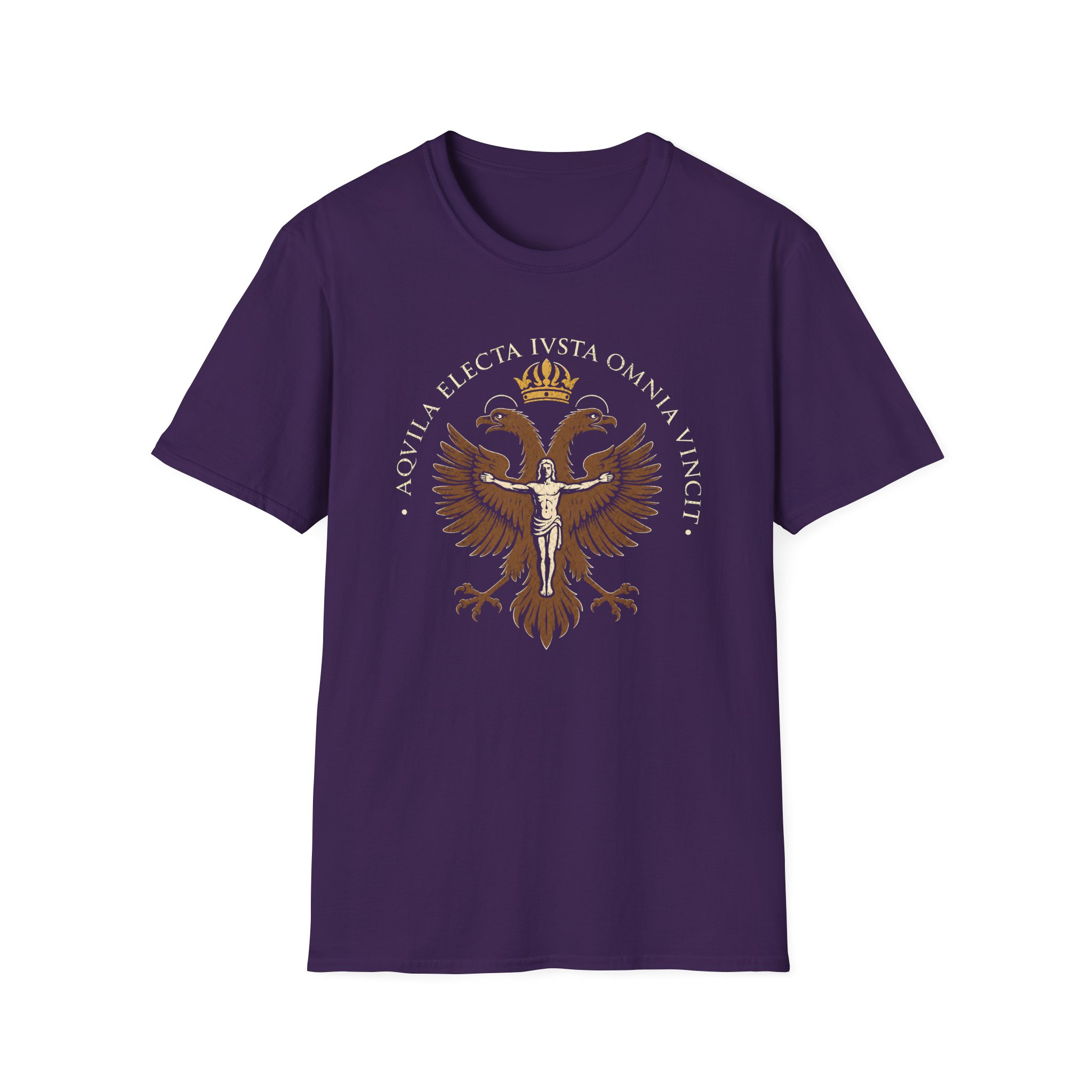
Wear a piece of Renaissance imperial symbolism with this historically inspired Latin T-shirt, featuring a crowned double-headed eagle, the Crucified Christ, and the inscription Aquila electa iusta omnia vincit.
The design is a modern adaptation of an authentic Habsburg emblem reproduced in Jacob Typotius’s Symbola Divina et Humana Pontificum, Imperatorum, Regum. The surviving engraving in the Rijksmuseum comes from the 1666 edition and was made by an anonymous engraver after Aegidius Sadeler. Typotius’s emblem book was first published in 1601, and the museum identifies this particular device with Ferdinand I, Holy Roman Emperor.
At its centre stands the double-headed imperial eagle, crowned and shown with its wings fully extended. Long associated with the Holy Roman Empire, the two-headed eagle evokes imperial authority, vigilance and dominion. Yet the most striking element is the figure of Christ crucified upon the eagle’s breast. The composition visually places the Cross at the heart of imperial power: earthly authority is not presented as supreme in itself, but as centred upon and subordinated to Christ.
The crown above the eagle reinforces its imperial character, while the crucifix transforms the heraldic bird into an explicitly Christian emblem. Together, the elements express a powerful union of faith, justice, sacrifice and victory—not merely conquest through force, but triumph governed by righteousness and the Cross.

The original inscription reads:
AQVILA ELECTA IVSTA OMNIA VINCIT
In classical spelling:
Aquila electa iusta omnia vincit.
The letters V and U were not consistently distinguished in Roman and later monumental lettering, which explains the historical spellings AQVILA and IVSTA.
A natural translation is:
“The chosen and righteous eagle conquers all.”
The initial letters form A–E–I–O–V, equivalent to A–E–I–O–U when the epigraphic V is read as U. The phrase therefore recalls the famously enigmatic A.E.I.O.U. device used by Emperor Frederick III and later associated with Habsburg dynastic identity. Its exact original meaning was never clearly revealed by Frederick, and hundreds of interpretations emerged over the following centuries.
Rendered in muted cream and warm brown against a charcoal-black background, the historical emblem has an aged, engraved appearance while remaining clear and striking. The result is a refined Holy Roman Empire shirt for lovers of Latin, Christian art, heraldry, European history and Renaissance emblem books.
| XS | S | M | L | XL | 2XL | 3XL | 4XL | 5XL | |
|---|---|---|---|---|---|---|---|---|---|
| Width, in | 16.00 | 18.00 | 20.00 | 22.00 | 24.00 | 26.00 | 28.00 | 30.00 | 32.00 |
| Length, in | 27.00 | 28.00 | 29.00 | 30.00 | 31.00 | 32.00 | 33.00 | 34.00 | 35.00 |
| Sleeve length, in | 7.99 | 8.23 | 8.50 | 8.74 | 9.02 | 9.25 | 9.49 | 9.72 | 9.96 |
| Size tolerance, in | 1.50 | 1.50 | 1.50 | 1.50 | 1.50 | 1.50 | 1.50 | 1.50 | 1.50 |