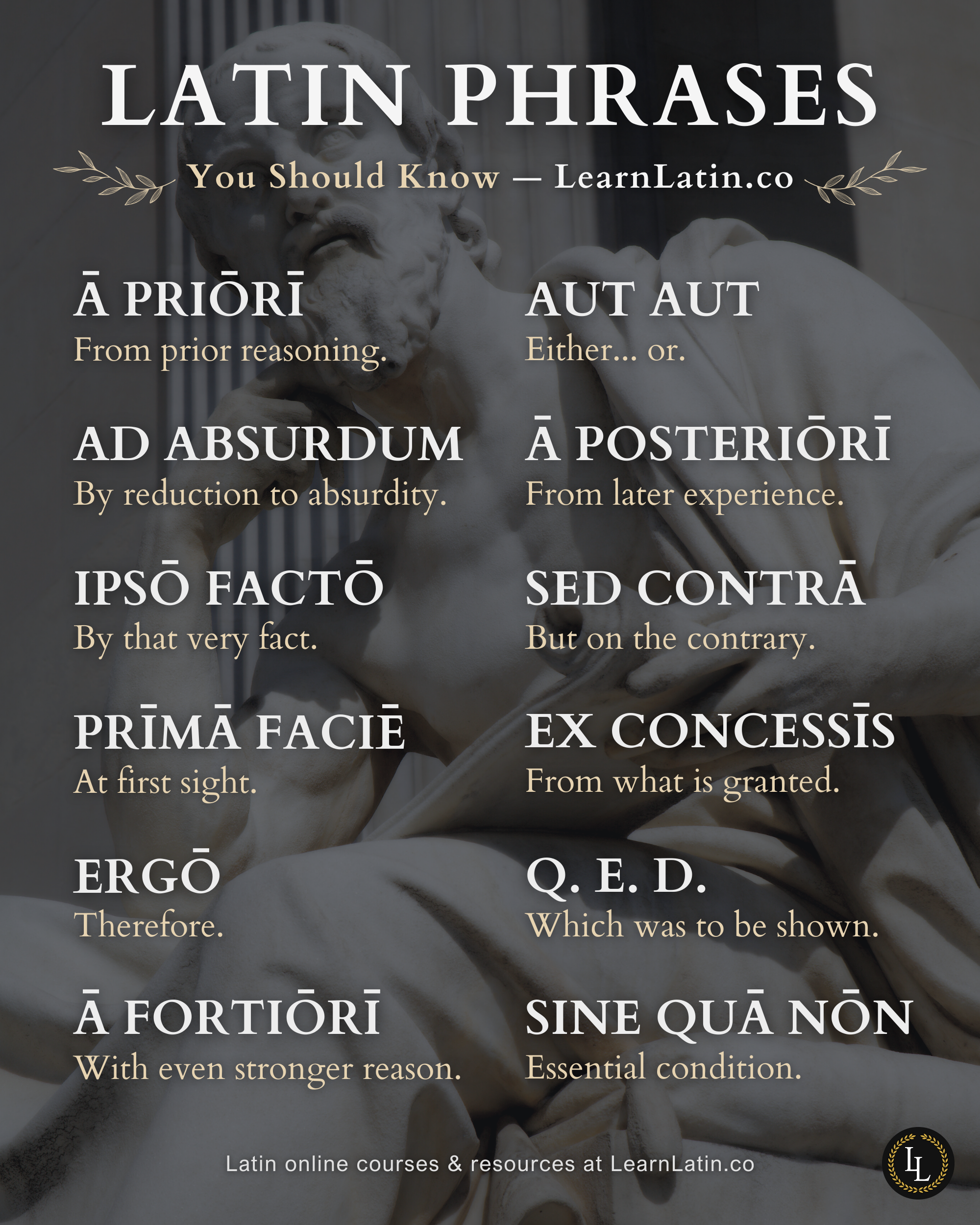
When we talk about logic and argumentation, we often use Latin without noticing.
Expressions like ergō, ā priori, or prima facie appear in philosophy, law, academic writing, and even everyday discussion. They sound familiar—almost naturally woven into modern English—yet for many people their precise meaning remains unclear, dulled by habit and casual use.
When used loosely, these expressions risk becoming empty labels of intellectual pretension. Used correctly, however, and with full awareness of their real meaning, they become powerful tools of thought, capable of sharpening both reasoning and the presentation of arguments.
This poster gathers a small yet complete selection of Latin phrases that remain central to how arguments are constructed and evaluated today. Each expression is accompanied by a clear and accurate English explanation that balances literal meaning with practical usage.
The goal is simple: to help readers recognize these terms when they appear, understand what they actually mean, and use them with intention rather than approximation. Read alongside the Logical Fallacies poster, this presents the constructive side of reasoning: how arguments are built and assessed.
For those who find this kind of precision appealing, learning Latin itself is a natural extension. My online course Latin I: First Steps begins from scratch and uses Familia Romana by Ørberg with the natural method, focusing on understanding Latin in context through reading rather than constant translation, dictionaries, or rote memorization.
These expressions remind us that Latin is not a relic of the past. It is a language that sharpens how we think and reason—even today.