When we find ourselves in the middle of a heated discussion, it is not uncommon for our opponent to resort to manipulation or faulty reasoning if they feel cornered by our arguments.
Wouldn’t it be extremely useful, then, to be able to detect these moves immediately and, with a simple and precise expression, dismantle these attacks on logic? This is where logical fallacies in Latin come into play.
Reason Like a Medieval Scholar
Terms such as ad hominem, post hoc, or non sequitur are still used today to name the most common errors in reasoning: attacks on the person rather than the claim, false causation, conclusions that simply do not follow.
These expressions survive because they condense into a single phrase what would otherwise take far too long to explain in the vernacular. Moreover, a strong argumentative tradition—extending all the way to medieval scholasticism—has efficiently crystallized their form and reinforced their use.
Move Beyond Empty Jargon
Yet these terms are often repeated mechanically, invoked as slogans rather than understood as precise diagnoses of how an argument has gone wrong. There is hardly anything worse than being accused by an opponent of using fancy words whose real meaning we do not actually know.
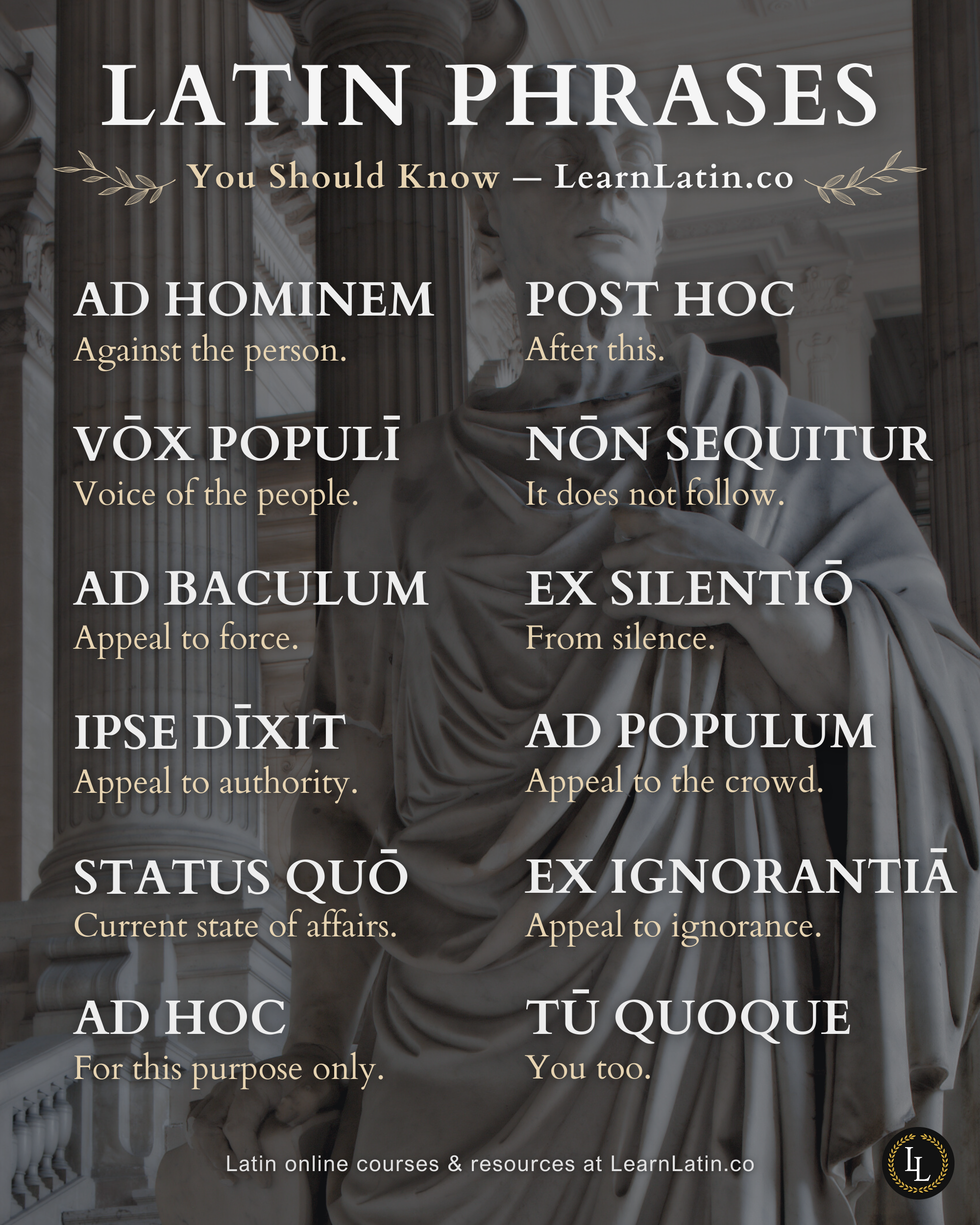
This poster brings together a small set of Latin phrases that name recurring logical fallacies and rhetorical distortions. Each term is paired with a clear English explanation—not to encourage jargon, but to sharpen recognition.
The goal is to help readers spot these patterns when they appear—in debate, media, or everyday conversation—and to distinguish persuasion from reasoning.
Seen alongside the Logic & Argumentation poster, this one completes the picture: how arguments should be constructed, and how they so often fail.
Your Next Step: Learn Latin
For those drawn to this kind of clarity, learning Latin itself is a natural next step. My online course Latin I: First Steps begins from the foundations and uses Familia Romana by Ørberg with the direct method, emphasizing understanding through context and reading rather than constant translation.
Latin does more than preserve old words. It gives names to the ways we think—and to the ways thinking drifts into deception.